Tesla's Berlin Factory Resumes Operations Following Arson Attack
Tesla's manufacturing facility in Berlin is slowly getting back on track as it re-establishes connection to the power supply on Monday after being shut down for a week due to an arson incident.
Production at Tesla's factory near Berlin is slowly starting up again after being offline for a week due to an arson attack. The plant was reconnected to the power grid late on Monday.
"The lights are back on," German energy network E.DIS informed CNN. They were able to switch the power back on at 8:45 p.m. local time. Since then, the factory has been receiving power again.
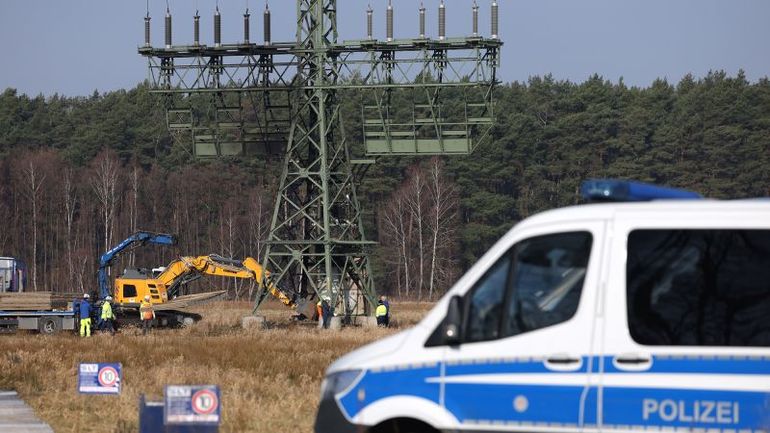
A group of activists known as the "Volcano Group" took responsibility for setting fire to an electricity pylon, causing a power outage at the Tesla plant last Tuesday. CNN affiliate RTL reported that production at the factory is expected to slowly increase. A Tesla spokesperson mentioned that it is uncertain when production will be back to normal. Originally, Tesla had anticipated the shutdown to last until the end of the week.
The outage could potentially have a significant impact on Elon Musk's company. The massive plant, which is situated approximately 30 kilometers southeast of the German capital, serves as Tesla's sole manufacturing facility in Europe and has the capacity to produce 375,000 electric vehicles annually.
In Germany, the starting price for Model Y vehicles, the exclusive cars produced at the factory, is €44,990 ($49,196). This translates to approximately €324 million ($354 million) in sales for Tesla for each week of production.
Analysts had cautioned that first-quarter earnings could be affected by a shutdown lasting around 10 days or more. However, they mentioned that the impact may be lessened due to low demand for EVs in Europe and the likelihood of Tesla catching up on production in the upcoming weeks.
CNN reached out to the company for a statement.
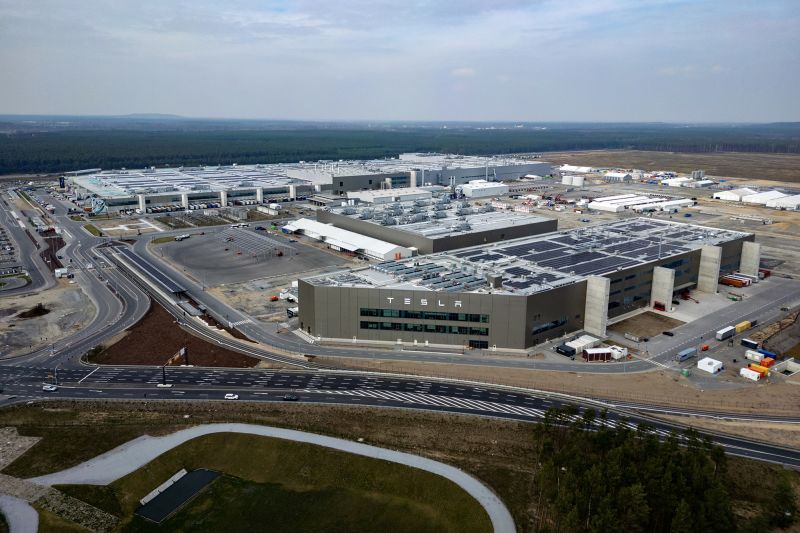
An aerial view of the Tesla car plant near Berlin on March 10, 2024.
An aerial view of the Tesla car plant near Berlin on March 10, 2024.
The Volcano Group recently stated in a letter posted on the alternative German media site Kontrapolis that they had intentionally disrupted Tesla's operations. They expressed concern that Tesla's plant was depleting Earth's resources and exploiting labor to produce 6,000 SUVs, killer cars, and monster trucks every week.
Elon Musk responded to X by stating, "These eco-terrorists must either be incredibly foolish or they are being manipulated by those with no genuine environmental interests. Halting the production of electric vehicles instead of fossil fuel vehicles is extremely foolish."
The company applied to boost the factory's production capacity to 1 million electric vehicles annually, aiming to become Europe's largest car plant. However, in February, residents opposed clearing the forest for Tesla's expansion. As a result, local authorities will determine the next steps.
Earlier this year, the carmaker faced another setback when it announced a temporary halt in production at the Berlin plant for two weeks. This was due to delays in the delivery of components caused by attacks on container ships in the Red Sea.
Reporting for this was contributed by Stephanie Halasz in London.
Editor's P/S:
The arson attack on Tesla's Berlin factory is a stark reminder of the challenges faced by the electric vehicle industry. While the environmental concerns raised by the Volcano Group are valid, their destructive actions are counterproductive and ultimately harm the very cause they claim to support. The production of electric vehicles is essential to reducing our reliance on fossil fuels and combating climate change.
The impact of the shutdown on Tesla's operations is significant. With the plant responsible for the production of 375,000 electric vehicles annually, the company could potentially lose millions in revenue. However, analysts believe that the impact may be lessened due to low demand for EVs in Europe and Tesla's ability to catch up on production in the coming weeks. It is important to note that Tesla has faced other setbacks in recent months, including a temporary production halt due to component delivery delays. Despite these challenges, the company remains committed to its mission of accelerating the world's transition to sustainable energy. engage with stakeholders to address environmental and social concerns while maintaining its production targets. Ultimately, a balanced approach that addresses both sustainability and economic growth is essential for a sustainable future.