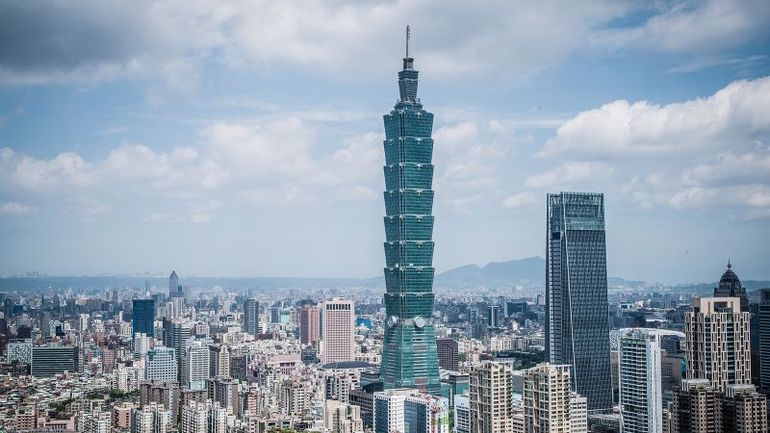
The Engineering Marvel of Taiwan's Tallest Skyscraper in Earthquake Resistance
Discover how deep foundations, structural flexibility, and a massive steel orb functioning as a pendulum safeguard the 1,667-foot-tall skyscraper in Taiwan from the destructive force of earthquakes.
The National Fire Agency (NFA) reported that the 7.4 magnitude earthquake that struck Taiwan caused the death of at least 9 individuals. The earthquake also resulted in over 100 buildings being damaged across the island. Approximately half of the damaged buildings were in Hualien County, near the epicenter, where four structures partially collapsed.
Despite the capital city Taipei being just 80 miles away from the epicenter, buildings experienced intense shaking during what was considered the strongest earthquake in Taiwan in 25 years. However, the Taipei 101, a once tallest skyscraper in the world, stood unharmed after the earthquake, showcasing the success of modern engineering.
Footage from the earthquake shows the 1,667-foot-tall tower swaying slightly, thanks to its structural flexibility that helps counter the powerful motion of the quake. This movement highlights how the skyscraper's main defense against earthquakes is the reinforced concrete it is built from.
The material combines the compressive strength of concrete with the tensile strength of steel, making the building flexible enough to sway but rigid enough to withstand high winds and typhoons common in Taiwan. This principle of buildings moving with seismic forces, rather than against them, has been a key feature of traditional architecture in earthquake-prone East Asian countries for centuries, from Japanese pagodas to Chinese palaces.
High within the tower, however, another technological innovation helps protect the 101-story skyscraper — a huge orb-like device known as a tuned mass damper.

A 660-ton spherical device called a tuned mass damper swings like a giant pendulum in the skyscraper's upper floors.
A 660-ton spherical device called a tuned mass damper swings like a giant pendulum in the skyscraper's upper floors.
Richard Chung TW/Reuters/File
Suspended from 92 thick cables between the 87th and 92nd floors, there is a giant golden steel sphere. This sphere has the ability to move about 5 feet in any direction. It acts like a pendulum that counteracts (or “dampens”) swaying motions.
"It's like a huge counterweight," said Stefan Al, author of "Supertall: How the World's Tallest Buildings Are Reshaping Our Cities and Our Lives," during our phone interview. "For Taipei 101, it weighs 660 tons. Although it sounds heavy, when you consider the entire building's weight, it's actually just a small part."

Christ Stowers Photography
Christ Stowers Photography
Christ Stowers Photography
Related article
How Taiwan’s new $220 million arts center radically rethinks theater design
When a building starts to shake, the tuned mass damper will move in the opposite direction. In the case of Taipei 101, it is suspended, so it will lag behind as the tower sways and will absorb the kinetic energy by moving in the opposite direction. Hydraulic cylinders between the ball and the building convert this energy into heat, which is then dispersed.
Tuned mass dampers are used in skyscrapers around the world, including the "super-skinny" Steinway Tower in New York and Dubai's sail-shaped Burj al-Arab, which has 11 of them. The device crucially protects against the violent motion caused by "harmonic vibration," which can cause structural failure during an earthquake.
Video Ad Feedback
Related video: A short history of the world's tallest buildings
04:24
- Source:
CNN
"When buildings reach their own resonance, they start to vibrate," he explained, likening it to a tuning fork. This vibration can cause the building to shake increasingly faster, potentially leading to a collapse.
Tuned mass dampers, also called harmonic absorbers, are specifically adjusted to resonate at the building's frequency. By varying the wavelengths slightly, they help to diffuse the dangerous energy that could result in disaster.
The stability they provide can also reduce the uncomfortable — or even nauseating — effect swaying can have on a building’s occupants in high winds.
Freedom Plaza
Bjarke Ingels Group
Related article
Two skyscrapers joined by daring cantilevered ‘skybridge’ to soar over New York
Structural support
Taipei 101, designed by C.Y. Lee & Partners from Taiwan, held the title of the world's tallest building from 2004 to 2007. It was later surpassed by the Burj Khalifa in Dubai. One of its main attractions is the observation deck, which offers a view of the innovative tuned mass damper. Visitors are particularly fascinated by the damper's movement during strong winds.
The giant sphere is not the only design feature that helps stabilize the tower, which is located near a major fault line. The skyscraper sits on deep foundations made up of 380 reinforced concrete and steel piles drilled into the bedrock below. Above these piles, the building's core is connected to massive steel outrigger trusses via "mega-columns" located around its perimeter.
Courtesy Komatsu Matere
Related article
How Japan spent more than a century earthquake-proofing its architecture
The high-rise building follows strict anti-seismic building codes due to its location on an island along the “Pacific Ring of Fire,” where significant seismic and volcanic activity occurs from Indonesia to Chile.
Although the design of the building has undergone thorough digital modeling and “shake table” testing to simulate earthquake movements, there is still some uncertainty about how Taipei 101 would respond to a more intense or closer seismic event.
Al mentioned that even with computer simulations, there is a unique quality about physical testing that cannot be replicated digitally. He emphasized that despite advancements in technology, testing designs in wind tunnels and shaker tables is still necessary.
Editor's P/S:
The recent earthquake in Taiwan and the resilience of the Taipei 101 skyscraper during the event are a testament to the advancements in structural engineering and the importance of earthquake preparedness. The skyscraper's ability to withstand the powerful tremors highlights the effectiveness of modern building techniques and the use of innovative technologies like tuned mass dampers, which help counteract the swaying motion caused by earthquakes.
The article also underscores the ongoing challenges in earthquake engineering, as even with advanced modeling and testing, there remains uncertainty about how buildings will respond to future seismic events. Physical testing in wind tunnels and shaker tables still plays a crucial role in evaluating designs and ensuring the safety of high-rise structures in earthquake-prone regions. The dedication of engineers to continuously improve and refine building techniques is essential for ensuring the resilience of our cities and protecting lives during these potentially devastating events.