The Bold Initiative of Harnessing Solar Energy from Space for Earth's Power Needs
Harness the limitless power of the sun with space-based solar farms Impervious to weather, darkness, or seasonal changes, this audacious plan promises to revolutionize energy generation
Ali Hajimiri, a professor of electrical engineering at Caltech, has dedicated ten years to studying the feasibility of placing solar panels in space and transmitting the energy to Earth. Despite his extensive research, he consistently faces three questions when discussing his work, typically in the following sequence: Why not simply install solar panels on Earth? Will this harm birds flying in the sky? Are you constructing a Death Star? In jest, Hajmiri quips that he intends to have the responses printed on a card for easy reference. "I'm planning to keep it in my wallet to share with people," he remarked.
Initially skeptical about space-based solar power, Hajimiri's perspective changed when he delved deeper into the concept. "On average, you get about eight times more power in space than on Earth," he explained to CNN. He also clarified that the solar beams will not harm animals and assured that the technology cannot be weaponized like the Death Star.
This year, Hajimiri and his team took a significant step forward in making space-based solar power a viable option.
In January, the team successfully launched Maple, a 30-centimeter-long space solar prototype with flexible, lightweight transmitters designed to harvest energy from the sun and transfer it wirelessly in space. The team achieved their goal by successfully lighting up a pair of LEDs.
However, they set a "stretch goal" to test if Maple could beam down detectable energy to Earth. In May, the team conducted a "dry run" to assess the potential. Positioned on a rooftop on the Caltech campus in Pasadena, California, the scientists were able to pick up Maple's signal.

A worker cleans solar panels at a new energy base in China.
Yuan Hongyan/VCG/Getty Images
After a terrible year of climate news, here are 5 reasons to feel positive
They were able to successfully transmit power wirelessly from space, although the energy detected was minimal and not particularly useful. "It was only later that we realized how remarkable this was," commented Hajimiri.
While space-based solar may seem like a futuristic and far-fetched concept, it has been around for quite some time. In fact, as early as 1941, science fiction writer Isaac Asimov described this idea in a short story. Despite initial exploration of the concept by countries such as the US, China, and Japan, it was largely dismissed for many years due to its impractical economics, as stated by Martin Soltau, CEO of Space Solar, a UK-based company.
The convergence of falling satellite launch costs, rapid advancement in solar and robotics technology, and the increasing urgency to transition to clean energy as a replacement for fossil fuels, is creating a pivotal moment in time. "There's a nexus of different technologies coming together right now just when we need it," stated Craig Underwood, emeritus professor of spacecraft engineering at the University of Surrey in the UK.
The problem is, these technologies would need to be deployed at a scale unlike anything ever done before.
What is space-based solar?
Space-based solar power is a simple concept at its core. By harnessing the sun's energy in space, it eliminates the issues of weather, cloud cover, and seasonal changes, providing a constant and reliable energy source. The idea involves launching large solar power satellites, over a mile in diameter, into a high orbit around the Earth.
Due to their immense size, these structures would consist of hundreds of thousands of mass-produced modules, similar to lego bricks, as stated by Soltau to CNN. These modules would be assembled in space by autonomous robotic assembly machines. The satellites' solar cells would harness the sun's energy, convert it to microwaves, and transmit it wirelessly to Earth using a large transmitter capable of precisely targeting specific points on the ground.

The illustration provides a visual comparison of the immense size of the CASSEioPia array, using the International Space Station and the Burj Khalifa, the tallest building in the world, for scale.
The microwaves can travel easily through clouds and bad weather, and they would be directed to a receiving antenna (or "rectenna") on Earth made of mesh. "Think of a sort of fishing net hung on bamboo poles," Soltau said. Once there, the microwaves would be converted back into electricity and fed into the grid.
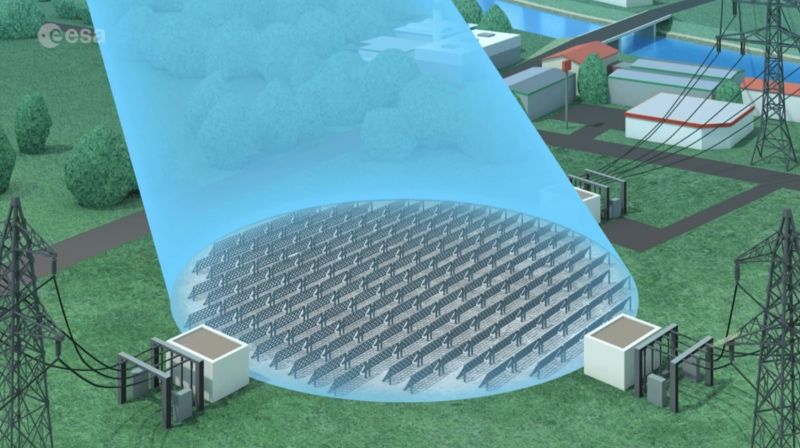
The transmission of power would occur wirelessly through microwaves to specific receiving stations on Earth known as "rectennas," which then convert the energy into electricity and supply it to the local grid.
The rectenna, which spans approximately 6 kilometers (3.7 miles) in diameter, has the potential to be constructed on land or offshore. These mesh structures are designed to be nearly transparent, allowing for the land beneath them to be utilized for solar panels, farming, or other activities.
A single space solar satellite could deliver up to 2 gigawatts of power, roughly the same amount as two average nuclear power plants in the US.
An idea whose time has come?
According to UK professor Underwood, space-based solar is not just science fiction. He stated that the technology is mature and the main obstacle has been the high cost of putting a power station into orbit. However, in the past decade, companies like SpaceX and Blue Origin have started developing reusable rockets, leading to a significant decrease in launch costs. Today, the launch costs amount to around $1,500 per kilogram, which is approximately 30 times less than during the era of the Space Shuttle in the early 1980s.
Mamatha Maheshwarappa, payload systems lead at UK Space Agency, stated that despite the perception of launching large amounts of material into space having a significant carbon footprint, space solar would likely have a footprint at least comparable to terrestrial solar per unit of energy, if not smaller, due to its increased efficiency as sunlight is available nearly constantly.

Drilling operations for white hydrogen by Natural Hydrogen Energyin the US Midwest.
Viacheslav Zgonnik
Fragment
They discovered fossil fuels on their hunting expedition. The discovery has the potential to significantly benefit the planet. Some experts argue that the carbon footprint of space-based solar energy could be cut in half compared to a terrestrial solar farm, despite the energy required for rocket launches.
Space-based solar is not intended to replace terrestrial renewables, but rather to provide baseload power that can be utilized day and night to compensate for when wind and solar energy are not available. This type of power is currently produced by fossil fuel or nuclear power plants, but space-based solar can offer a more portable solution, according to Peter Garretson, a senior fellow in defense studies at the American Foreign Policy Council. He stated that the power could be transmitted from space to various locations, such as from the top of Europe to the bottom of Africa.
Advocates emphasize the potential for space-based solar to provide abundant, affordable energy to developing countries with energy needs but limited infrastructure. They argue that with just a rectenna, these countries could benefit from a real democratization of energy. Additionally, space-based solar could be utilized to power remote Arctic towns and villages that experience months of darkness each year, and to provide support to communities facing power outages during climate disasters or conflict.
The challenges
There is still a huge gulf between concept and commercialization.
"We are experts in satellite and solar array construction," said Maheshwarappa of the UK Space Agency. "However, we have yet to master the building of such large structures in space. For instance, the Burj Khalifa in Dubai, the world's tallest building at around 830 meters or approximately 2,700 feet, pales in comparison to the structures we envision for space, which would be twice the size. Building something of this scale is unprecedented on Earth, let alone in space."

The Climeworks factory, located near Reykjavik in Iceland, features large fans in front of the collector. These fans draw in ambient air, which is then released as largely purified CO2 through ventilators at the back. The factory is composed of containers stacked in pairs, reaching a height of 10 meters (33 feet). This innovative process helps mitigate carbon emissions and reduce environmental impact. (Photo by Halldor KOLBEINS / AFP) (Photo by HALLDOR KOLBEINS/AFP via Getty Images)
Halldor Kolbeins/AFP/Getty Images
What is carbon capture? Some say it will help save the world, for others its a dangerous distraction
Scientists are faced with the challenge of developing AI and robotics for the construction and maintenance of structures in space, as the necessary technologies are still in early stages of development. In addition, there is a need to regulate the new energy system to ensure sustainable satellite construction, minimize debris risk, create end-of-life plans, and establish suitable rectenna site locations.
Maheshwarappa mentioned that getting public support could be a significant challenge. There is often a natural apprehension about transmitting power from space.
However, some experts believe that these fears are baseless. The energy density at the heart of the rectenna would only be a quarter of the midday sun. "It's like standing in front of a heat lamp," Hajimiri explained.
Hajimiri noted that constructing a satellite with the potential to cause harm would require significantly larger size than the current designs in development. He emphasized that any attempt to build such a satellite would not go unnoticed. However, he also stressed the importance of asking questions and ensuring that the ultimate goal is to benefit humanity, otherwise it would serve no purpose.

An artists impression of what a solar power satellite could look like
ESA
For some, however, the whole concept of space-based solar is misplaced.
According to Amory Lovins, a physicist and adjunct professor at Stanford University, the focus should be on terrestrial renewables, as the extra energy in space is not valuable enough to justify the cost of collecting and beaming it down. Additionally, Lovins believes that the promises of space-based energy as a great source of baseload power do not hold up, and instead argues that there are techniques to match energy demand to supply without consumers even noticing. He also considers a huge power source that is constantly producing energy to be "undesirably inflexible."
"Why invest in something that has no potential for a viable business case if successful, whose demand will have already been fulfilled before it can be developed, and whose most optimistic projected costs match the current cost of land-based solar power plus batteries?" he inquired.
The future
Governments and companies globally see great potential in space-based solar to address the growing need for clean energy and combat the climate crisis. According to Soltau, it will take approximately five to six years to demonstrate proof of concept for the development program. Following that, an additional five to six years will be needed to industrialize and scale up the gigawatt-scale system for full operational use.
He emphasized the importance of strong government support, stating, "Developing a new energy technology is an ambitious endeavor." In 2025, the Air Force Research Laboratory in the US plans to launch a small demonstrator named Arachne, while the US Naval Research Laboratory launched a module in May 2020 aboard an orbital test vehicle to test solar hardware in space conditions.
The China Academy of Space Technology, a leading spacecraft designer and manufacturer, has set its sights on deploying a solar satellite in low orbit by 2028 and in high orbit by 2030, as reported by the South China Morning News in 2022.

An illustration of what a space solar satellite could look like. Governments around te world are investing in programs to research and develop the concept.
Andreas Treuer/ESA
The UK government has recently sparked a flurry of activity, beginning with an independent study in 2021 that confirmed the technical feasibility of space-based solar. This study highlighted the UK-led CASSIOPeiA design, a satellite with a diameter of 1.7 kilometers (1 mile) that aims to deliver 2 gigawatts of power. In addition, the government announced a funding of nearly $5.5 million to universities and tech companies in June of this year, with the goal of driving innovation in the space-based solar sector.
Europe also has its own Solaris program, which aims to establish the technical and political viability of space-based solar. This initiative is in preparation for a potential decision in 2025 to launch a full development program.
"Before construction begins, everything is speculative," Garretson stated. "However, there are compelling reasons to believe that this could be both economically feasible and sustainable."
Meanwhile, in California, Hajimiri and his team have dedicated the past six months to rigorously testing their prototype in order to gather data for the next iteration of design.
Hajimiris envisions a series of lightweight, flexible sails that can be easily rolled up, launched, and unfurled in space. These sails consist of billions of elements that work in perfect synchronization to send energy where it is needed.
He sees their project as a part of a long chain of people building upon each other's work and offering help. "We are taking an important step, perhaps, but it is not the last step," he said.