Supreme Court Case: New York's Influence on Businesses' NRA Ties Under Scrutiny
Delve into the Supreme Court's upcoming deliberations on a controversial case involving New York's alleged pressure on financial institutions to cut connections with the National Rifle Association. The National Rifle Association challenges a New York regulator's actions, sparking a unique First Amendment debate on freedom of association and business relationships.
The National Rifle Association is bringing an unusual First Amendment appeal to the Supreme Court on Monday. The appeal is against Maria Vullo, the former superintendent of the New York Department of Financial Services. She convinced banks and insurance companies to cut ties with the NRA.
The NRA alleges that Vullo not only pressured insurance companies to separate from the gun rights group but also warned of enforcement actions against firms that did not comply. Vullo disagrees with this claim.
The appeal will test how far government regulators – liberal or conservative – may go in pressuring the companies they police to do business with controversial entities.
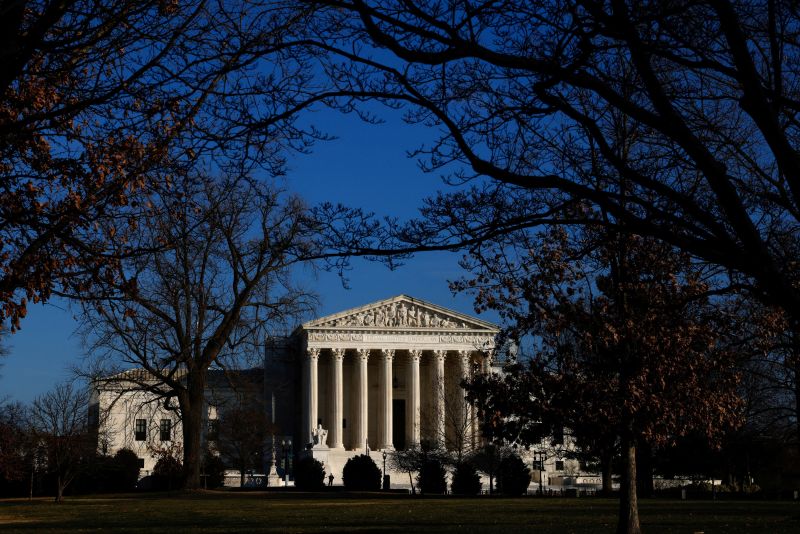
View of the U.S. Supreme Court building in Washington, U.S., January 8, 2024.
View of the U.S. Supreme Court building in Washington, U.S., January 8, 2024.
Julia Nikhinson/Reuters
Related article
Supreme Court to debate whether White House crosses First Amendment line on social media disinformation
Caroline Fredrickson, a Georgetown Law professor, expressed concern about the possibility of state governments using regulatory power to pressure third parties. She warned that regulators from different political affiliations could influence insurance companies and banks to stop providing coverage for certain advocacy groups or companies.
Fredrickson emphasized the importance of not limiting regulators from influencing which insurance company provides coverage.
In New York, Vullo took action against a type of insurance that is against the law: third-party policies from the NRA that cover costs related to personal injury and legal defense after using a firearm.
Some critics called the policies "murder insurance." According to Vullo, other insurance companies stopped working with the NRA because they no longer wanted to be associated with the group. Some of these companies ended their relationship with the NRA after the 2018 mass shooting at a Parkland, Florida, high school where 17 people lost their lives.
The NRA claims that a meeting took place in 2018 between Vullo and Lloyd’s of London. During this meeting, Vullo allegedly suggested that other violations would not be prosecuted if the company assisted in the campaign against gun groups.
In a brief to the high court, the NRA emphasized that while government officials are entitled to express their opinions, they should not abuse their power to influence others to penalize speech based on its perspective.
Vullo downplayed the importance of the meeting in court documents, saying that the NRA's claims are not detailed. She previously worked in the administration of Democratic ex-Governor Andrew Cuomo before stepping down in 2019.
The US District Court denied some of the NRA’s claims but allowed its First Amendment arguments to proceed against Vullo. The 2nd US Circuit Court of Appeals reversed that decision, stating that Vullo’s actions were not coercive. It also determined that Vullo was entitled to qualified immunity, which is a legal concept that protects government officials from lawsuits in certain situations.
US Circuit Judge Denny Chin emphasized that government officials cannot use their regulatory powers to force individuals or entities to refrain from protected speech. However, he also highlighted that government officials have the right and responsibility to address issues of public concern.
The NRA is basing its argument on a 1963 Supreme Court case, Bantam Books v. Sullivan. This case involved a Rhode Island commission threatening distributors with police referral for selling books considered obscene. The Supreme Court ruled that this form of "informal censorship" was unconstitutional.
On Monday, the Supreme Court will hear a related case that involves the White House, federal agencies, and social media. In this case, Republican officials from two states and five social media users are alleging that the Biden administration violated the First Amendment. They claim that the administration tried to pressure platforms like Facebook and X to remove disinformation, which they view as coercion.
Editor's P/S:
The NRA's appeal to the Supreme Court raises important questions about the limits of government regulators' power to influence private companies' business decisions. While regulators have a legitimate role in addressing public concerns, they must exercise their authority in a manner that does not violate the First Amendment rights of individuals or entities. The NRA's allegations against Vullo, if proven, would constitute a clear abuse of power that undermines the principle of free speech.
The Supreme Court's decision in this case will have far-reaching implications for the relationship between government regulators and the private sector. It will also provide guidance on the scope of government's ability to regulate speech, particularly in the context of controversial or unpopular viewpoints. The outcome of the case will be closely watched by both supporters and opponents of gun rights, as well as by those concerned with the protection of free speech in the digital age.