Infrastructure Projects Advanced by Bipartisan Legislation: A Glimpse into a Futuristic Airport Terminal, Fish Passage, and Ski Town Bus Lanes
The $12 trillion bipartisan infrastructure law, signed by President Biden, has funded over 40,000 projects across America From upgrading airports and bridges to improving train travel and building fish passages, this historic investment is already making a significant impact on the nation's infrastructure
Since President Joe Biden signed the $1.2 trillion infrastructure law two years ago, over 40,000 projects have received federal funding. However, the impact of this historic investment may not yet be noticeable to many Americans. Construction has yet to begin in many areas, and the deteriorating infrastructure of the nation continues to be a newsworthy issue. For example, Vermont's roadways were unable to withstand historic rainfall this year, leaving residents stranded and businesses shut down. Additionally, a train derailment in Ohio released poisonous fumes into the air and resulted in the death of thousands of fish.
The Biden administration is keen to demonstrate the impact of this bipartisan-supported law before the 2024 election, with signs and billboards showcasing the projects funded by the law. In addition to funding for roads and bridges, the law also supports the creation of a nationwide network of electric vehicle chargers, increased access to high-speed internet, improved public transportation, and upgraded ports.
The full impact of the additional infrastructure spending on the US economy is still uncertain at this early stage. The federal government has until 2026 to distribute the funds, and some large-scale projects will require an extended period for completion.
The following are five projects that have already received funding from the legislation:
Upgrading Boston Logan International Airports Terminal E
Terminal E at Boston Logan International Airport has been transformed into a vibrant, spaceship-like facility following extensive renovations earlier this year. The upgrades were made possible in part by a $62 million grant from the infrastructure law.
Construction at Terminal E commenced in 2019, before the passage of the law, leading to the addition of four new gates. Furthermore, enhancements were implemented in the HVAC system, ticket area, baggage claim area, and jet bridges.
Additionally, a portion of the federal grant is allocated for the improvement of the arrival roadways for Terminals A and E, as well as the roadway connecting Terminals C and E.
The airport received the grant last year from the infrastructure laws Airport Terminals Program, which will award $1 billion each year for five years.
Replacing an aging bridge over the Wisconsin River
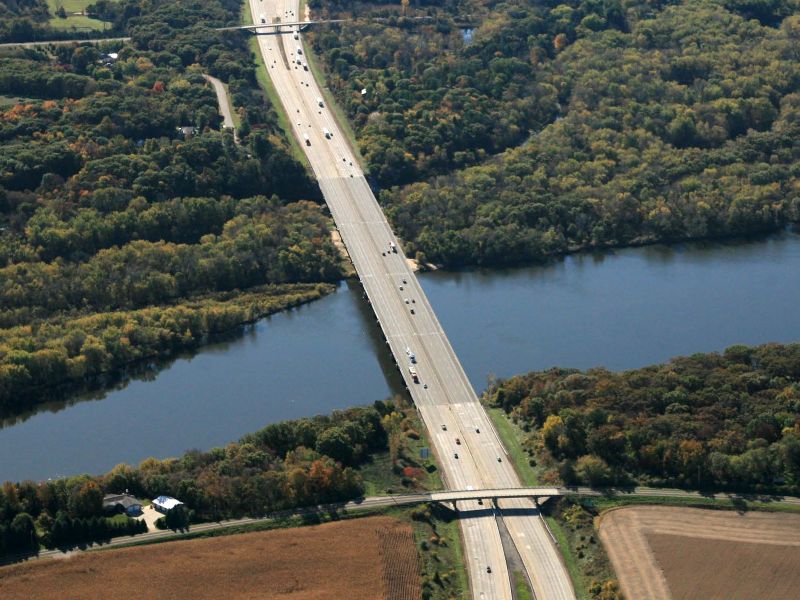
The I-39/90/94 bridge, which crosses the Wisconsin River, is set to be replaced.
WisDOT announced that the I-39/90/94 bridge over the Wisconsin River in Columbia County will be replaced with two new bridge spans, funded by $80 million from the federal infrastructure law. Construction is anticipated to commence next year.
The Wisconsin Department of Transportation has indicated that the bridge is approaching the end of its operational lifespan. Additionally, the department plans to replace two overcrossing bridges for county roads U and V. It is important to note that approximately 23% of the bridge's current traffic consists of trucks, as the route connects major economic centers such as Milwaukee, Chicago, and Wisconsin's capital city of Madison, which is located approximately 45 minutes south of the I-39/90/94 bridge.
The route links important tourist spots and contributes significantly to Wisconsin's tourism income from neighboring counties. According to the Wisconsin DOT, the bridge is among the limited few that span the Wisconsin River in the southeastern region of the state.
Dedicated electric bus lanes running in and out of Park City, Utah
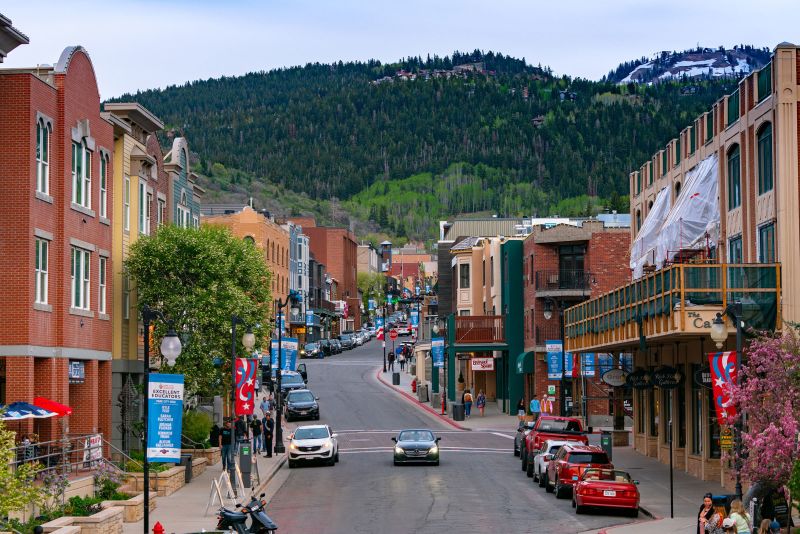
Park City Main Street Historic District on May 29, 2021, in Park City, Utah.
AaronP/Bauer-Griffin/GC Images/Getty Images
Park City, a popular Utah ski town, offers a free electric bus service that runs from the historic district to the Kimball Junction neighborhood. The intended travel time is 10 to 15 minutes, but delays due to traffic congestion occur about one-third of the time.
Efforts to improve the route's efficiency have been ongoing since 2018, with local officials considering the addition of dedicated bus lanes along State Route 224. This year, the project secured $25 million from the infrastructure law to support its implementation.
Improving train travel along the Northeast corridor
The construction is anticipated to commence in the coming year. Alongside the creation of two 12-foot-wide lanes, one for each direction, the project entails the construction of two new bus stations, the enhancement of three existing stations, and the acquisition of five additional electric buses.
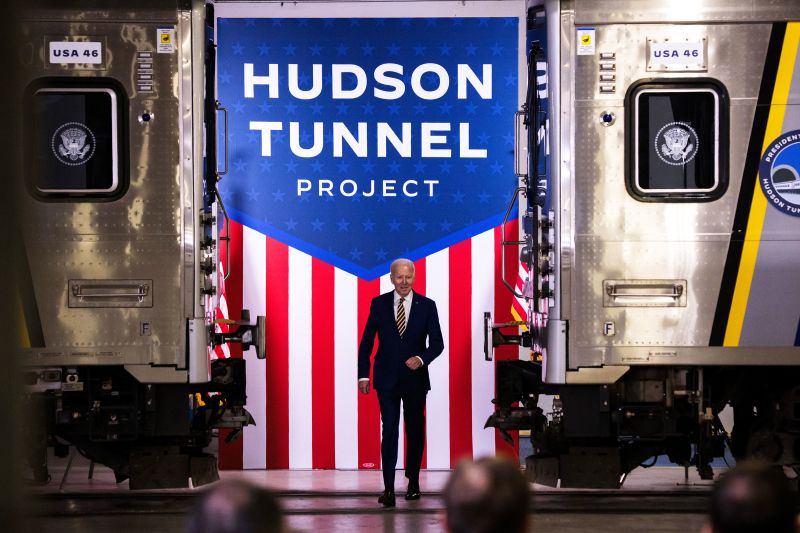
President Joe Biden arrives to give a speech on the Hudson River Tunnel Project at the West Side Yard on January 31, 2023, in New York City.
The infrastructure package includes billions of dollars allocated to numerous projects aimed at enhancing train travel along the bustling Northeast corridor from Boston to Washington, DC.
Funding is being directed towards the major project of reparing the rail tunnel that connects New Jersey with Manhattan, running under the Hudson River. The tunnel, which first opened in 1910, has been plagued by age-related issues and was further damaged by Hurricane Sandy's salt water inundation in 2012.
Additionally, in Maryland, initial construction has started to replace the 150-year-old Baltimore and Potomac Tunnel that runs beneath the city of Baltimore. The plan is to replace it with two new tunnels for Amtrak and Maryland Area Regional Commuter (MARC) trains.
The anticipated improvements will raise train speeds in the tunnel from 30 mph to 110 mph. In addition, the more than century-old Susquehanna River Bridge in Maryland and the Connecticut River Bridge are set to be replaced.
Building a fish passage around Washingtons Howard A. Hanson Dam
The infrastructure legislation designated $22 billion specifically for Amtrak, a portion of which is currently earmarked for the replacement of over 1,000 railcars and locomotives. A number of the new railcars are already in operation.
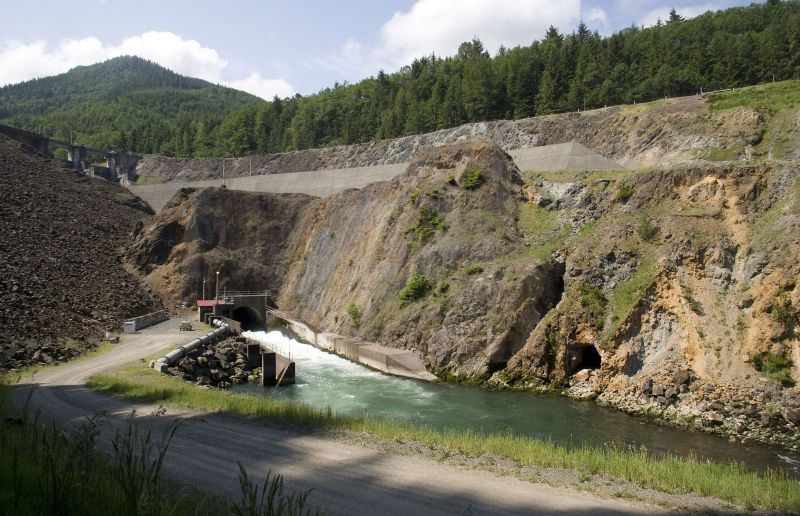
In this 2009 photo, water flows from the Howard A. Hanson Dam in East King County, Washington.
The Howard A. Hanson Dam, constructed in 1961, has been instrumental in safeguarding the Green River Valley in Washington from flooding. However, it has also posed a threat to the Chinook and Coho salmon as well as the steelhead populations.
Earlier this year, the infrastructure law provided the US Army Corps of Engineers with $220 million to finish construction on a fish-passage facility. Once completed, this facility will enable fish to navigate around the dam, reopening over 60 miles of habitat.
For several years, lawmakers in Washington have been advocating for federal funding for this project. By increasing the populations of salmon and steelhead fish, the project aims to provide support for the endangered "Southern resident" killer whales, which are primarily located off the coasts of British Columbia, Washington, and Oregon.
The fish passage will also contribute to the preservation of the water supply for the Tacoma Public Utility. According to Seattle District Commander Col. Alexander L. Bullock, "A new downstream fish passage facility at Howard Hanson Dam is the most significant project that the US Army Corps of Engineers can undertake to support the recovery of Puget Sound salmon and orcas without adversely affecting other user groups." This statement was made last year.