Deciphering the Twist Ending of As Above, So Below: Unveiling the Infernal Truth
Discover the profound meaning behind As Above, So Below and unravel the mysterious twist ending that reveals a descent into the depths of hell.
Despite being a cleverly confusing horror movie, the ending of As Above, So Below actually explains its twists. This found-footage horror film may seem straightforward, but to fully appreciate it, you need to understand the history of alchemy and the works of Italian poet Dante. The movie's plot revolves around Scarlett, an alchemy student on a quest to find the philosopher’s stone. This legendary object, said to grant immortality and transform metals into gold and silver, was supposedly discovered by French alchemist Nicolas Flamel in the 14th century.
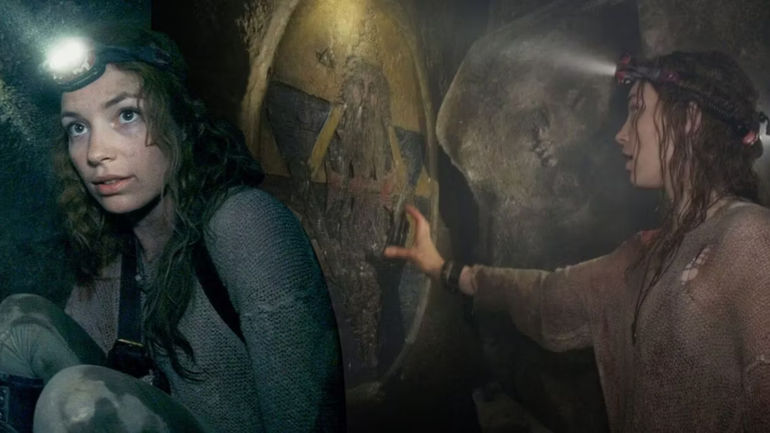
Scarlett follows in her late father’s footsteps, who perished while pursuing the stone. She eventually learns that the stone is hidden in the tight catacombs beneath Paris. Gathering a team to join her, they embark on an exploration of the catacombs. Their journey is reminiscent of Dante's Inferno, where the narrator descends into Hell and traverses its nine circles in search of salvation. Just like Dante, the characters in As Above, So Below must navigate the catacombs, each stage representing a circle of Hell, and confront their own sins in order to escape, even though not all of them are capable of doing so.
The As Above So Below Ending Is About Redemption
The Cult Found Footage Movie Mirrors Dante's Inferno
At the end of As Above, So Below, only three people are left - Zed, a seriously injured George, and Scarlett, who believes she has the philosopher's stone. Zed's regrets focus on his estranged son, while George feels guilt over his brother's accidental death. Scarlett carries the weight of not answering her father's cry for help before his suicide, as well as the act of stealing the stone.
Ultimately, the ending of As Above, So Below reveals that the movie is ultimately about redemption and faith.
Scarlett rushes back through the catacombs to rectify their sins and escape. She realizes the stone's powers are in the holder, dependent on her faith in it and in herself. With this newfound knowledge, Scarlett brings George back from the brink of death.
The remaining survivors of As Above, So Below confess their sins and emerge topside on the streets of Paris through a manhole. This echoes what one of the catacombs' apparitions mentioned earlier - the only way out is down. Just like how Dante escaped in Inferno, by descending through the circles of Hell, he emerged back on Earth.
As Above So Below Is Inspired By True Events
The ending of As Above, So Below is all about redemption and faith. While the film may not be the easiest to follow, its surprising twist ending, unique portrayal of Hell, and references to Dante make it stand out as a horror film with a deeper message.
The Haunting Catacombs Of Paris Actually Exist
One specific story from the catacombs directly inspired the plot of As Above, So Below.
One interesting aspect of As Above, So Below is that it is based on true events. The Paris catacombs, which serve as the setting for the film, are real. Over the years, numerous urban legends about ghosts and supernatural phenomena have emerged from the catacombs. This is not surprising considering that the catacombs were filled with the bones of the deceased by Louis XVI, leading to tales of spirits and demonic beings haunting its depths.
Interestingly, a specific story from the catacombs served as the direct inspiration for the plot of As Above, So Below. In the early 1990s, a group of explorers, led by Francis Freedland, ventured into the catacombs and stumbled upon a camera. Upon watching the footage, they discovered that the person behind the camera was lost in the catacombs. This real-life discovery was akin to a found footage horror movie, predating the popular genre that would later emerge.
Would a Sequel to "As Above, So Below" Change the Ending?
Over the years, many individuals have ventured into the catacombs never to return, such as a young girl exploring in 2005. Despite the release of the movie, people continue to become lost in the catacombs, with two teenagers in 2017 being fortunate enough to be rescued by authorities. While the conclusion of "As Above, So Below" suggests a story of redemption, the horror depicted in the film is also inspired by real-life events.
There Are Pros and Cons To As Above, So Below 2
As Above, So Below feels like a movie with a rich mythos behind it, and a sequel could explore this.
While the As Above, So Below ending explained its plot twists, many viewers felt dissatisfied by the horror film's finale. The critics' score is a very low 28 percent on Rotten Tomatoes and the audience score is not much higher at 40 percent, and the ending may be a big factor in this. That being said, there are still many fans of cult found footage movie As Above, So Below who've gone online to vocalize their desire for a sequel.
On the one hand, an As Above, So Below sequel could add to the ending. Creating another story where people have to go through Dante's Inferno could be used to explain the fates of the characters of As Above, So Below, and clear up some of the ambiguity around what actually happened in the final few minutes before the credits rolled.
As Above, So Below has a rich mythos that could be further explored in a sequel. The first movie left many questions unanswered, adding to the tense and terrifying experience on screen. A sequel could provide more insight into the story.
On the other hand, there is a risk that a sequel may not live up to the divisive ending that made As Above, So Below a cult classic. The ambiguity of the original ending has sparked discussions, theories, and kept the movie in viewers' minds long after it ended. A sequel would be a risky move, as it may not capture the same magic.
Editor's P/S:
The article provides an in-depth analysis of the ending of "As Above, So Below," highlighting its connection to Dante's "Inferno" and the theme of redemption. The film's exploration of the catacombs as a representation of Hell is intriguing, and the ending reveals the importance of faith and the need to confront one's sins. The article also delves into the real-life stories that inspired the film, adding a layer of authenticity to the horror depicted in the movie.
However, the article also acknowledges the mixed reception the ending received, with some viewers feeling dissatisfied. It raises the question of whether a sequel could address these concerns or potentially diminish the impact of the original film's ambiguous ending. The article suggests that a sequel could explore the rich mythos of the film and delve deeper into the characters' fates, but it also acknowledges the risk of not living up to the cult classic status the original film has achieved.